
The 3-Question Formula for More Listening and Less Talking
If you struggle with…
- Getting feedback from direct reports
- Knowing how & where to support your team
- Relinquishing control and letting your team take more ownership over their projects
…then hopefully today’s email will be very useful for you! I’m sharing a framework that I teach my clients. And I use these questions myself in nearly every coaching session.
Let’s break it down.
The 3-Question Framework: The Coach Approach In Action
Imagine you’re in a one-on-one with your direct report and they just completed a big, important project. You could say “good job,” then launch into your own feedback and insights.
But that’s not the most effective way for your team members to learn and grow from their experiences. Rather, they’re more than likely to come away with, “Ok, next time I should do such-and-such because that’s what my manager wants.”
Coach-like leadership involves more listening than talking. So a better way to coach up your team is to flip the conversation.
Before telling them what YOU think, it’s important to hear what THEY think.
And that means asking the right questions. But how do you know what to ask on the spot? That’s where the framework comes in.
The basic formula is this:
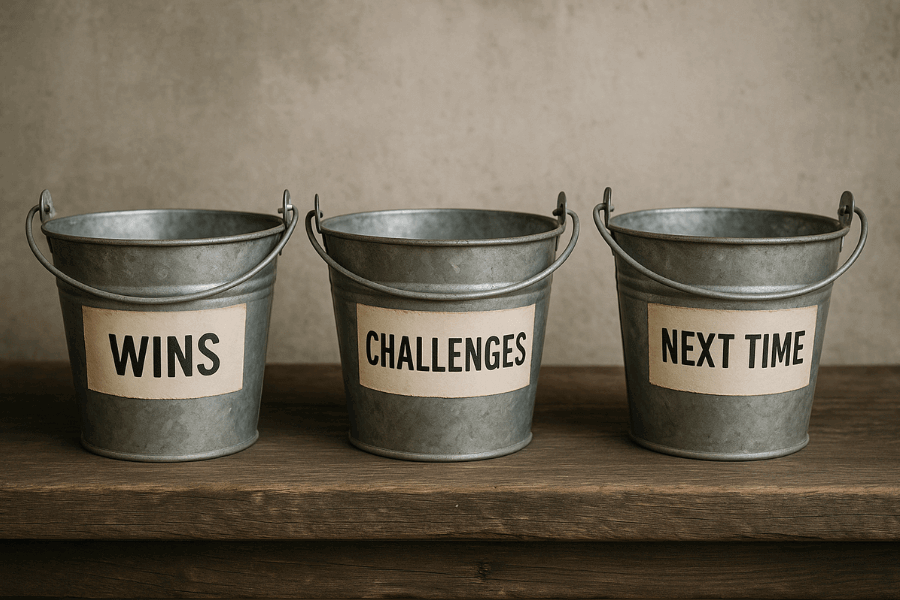
- What went well?
- What could have gone better?
- What do you want to do next time?
These questions create space for deeper insight…and it’s their insight, not yours.
Guided Reflection: How to Use the Framework
Essentially, the 3-question framework invites people to reflect on their wins, challenges, and improvements for the future.
In an actual conversation, here’s how you might lay it out:
➡️ “You’ve just wrapped up this big project. What went well?”
- Encourages them to celebrate wins and lets you celebrate with them. (In our hard-driving work cultures, celebration is usually an under-developed muscle.)
- Sets the tone for the conversation by starting with the good stuff.
- Helps them see what they should continue to do or do more of in the future.
- Gives you insight into their thinking and their priorities.
➡️ “As you think back on the rough spots, what could have gone better?”
- Lets them own their mistakes and shortcomings without you pointing them out.
- Gives them a chance to highlight other circumstances or challenges that impacted the project, beyond the ones they could have controlled.
- Frames the problems as learning opportunities.
- Tells you what issues they are already aware of so you don’t harp on them unnecessarily.
➡️ “In light of all that, what would you want to do next time?”
- Shifts the focus to the future.
- Helps them clarify and apply their key learnings.
- Moves them from reflection to commitment.
- Lets them verbalize intentions, making those intentions more solid
This three-question structure is effective, adaptable, and easy to remember. It’s also simple to tweak for specific scenarios.
For example, if your direct report is working on a solving a particular problem or learning a new skill, you can ask:
- When have you been successful with [problem/skill] recently?
- What’s been getting in your way?
- What have you learned that can help in the future?
The questions can change to fit the scenario, as long as you stick to the wins + challenges + next time formula.
Putting It Into Practice
I definitely hope you start using this framework in your leadership role…but before that, I encourage you to practice with yourself.
As a solo entrepreneur, I use this framework regularly to reflect on myself and my efforts. I usually type out the answers to the three questions and save them digitally so I can easily find them later if I want to come back to my reflection.
Try this for yourself. It might help to post a note on your laptop to remind you about the three questions, but once you’ve used them a few times, and see for yourself how well they work, the habit will become ingrained.